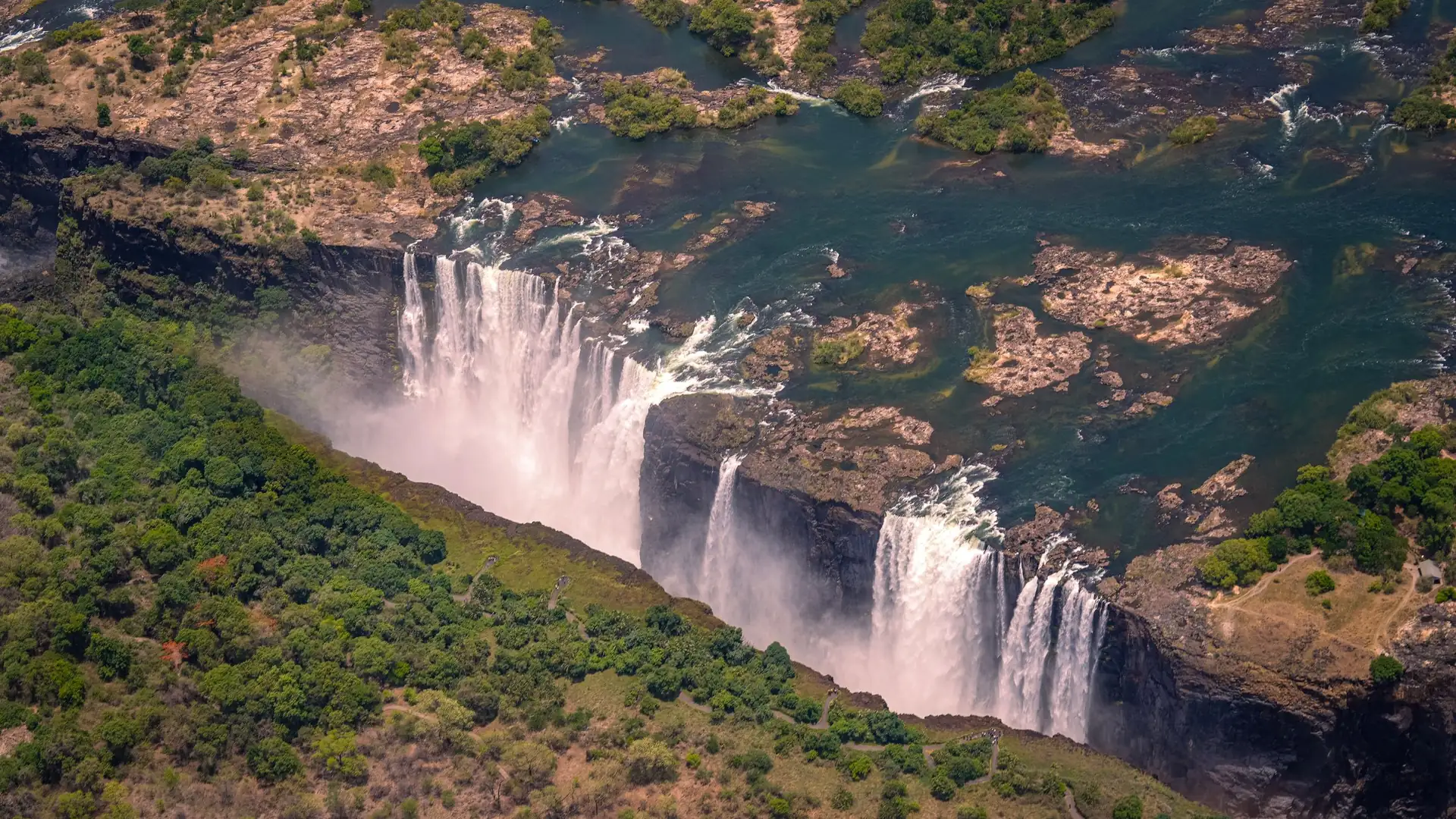
Filming at Victoria Falls — Zimbabwe The Falls, from the side with the view

Most of the curtain of water faces the Zimbabwe bank, and the rainforest path runs right along it. Here is what a crew needs to know before booking flights: who gives permission, when the water and the light are right, and what a drone will and will not be allowed to do.

  • From Harare9 h road, 1 h 20 air
  • Best light06:10 to 07:30, backlit
  • Sound floorThe roar near the rim; quiet upstream
  • Permit lead14 days, parks and drone

At a glance — Victoria Falls

The short answer

Filming at Victoria Falls needs a Zimbabwe filming permit and the parks authority’s permission, with about two weeks’ lead time. Drones need separate aviation clearance. July and August balance water, mist and light best.

Permission from
The national filming permit, plus Zimbabwe Parks and Wildlife Management Authority (ZimParks) for the rainforest and the river
Lead time
About 14 days; longer with a drone or after-hours access
High water
Roughly February to June, peaking around April
Low water
Roughly September to December
Drones
Separate aviation clearance and park consent. Drone rules
Nearest airport
Victoria Falls International (VFA)
Pairs with
Hwange National Park, about three hours by road

Last reviewed . Field figures are indicative and confirmed at recce. Rules and lead times change, and I check them for every production.

The Zambezi dropping into the gorge at Victoria Falls Victoria Falls

The place — Mosi-oa-Tunya

What you are actually filming

Victoria Falls is where the Zambezi, about 1.7 kilometres wide, drops more than 100 metres into a single basalt gorge. Its older name is Mosi-oa-Tunya, the smoke that thunders, and in high water you see the spray from the road long before you see the falls. It has been a UNESCO World Heritage Site since 1989, shared between Zimbabwe and Zambia.

The Zimbabwe side faces most of the falling water. The rainforest path inside Victoria Falls National Park follows the edge of the gorge directly opposite the falls, with a run of numbered viewpoints from the Devil’s Cataract at the western end, past Main Falls and Horseshoe Falls, to Danger Point by the bridge. For a camera that means the whole width of the falls, head-on, on foot, from public paths.

Beyond the falls there is far more country to use: the Batoka Gorge below, the wide upper Zambezi with its islands and sunset light, the 1905 Victoria Falls Bridge, and a town that exists to look after visitors, which makes logistics easier here than almost anywhere else in Zimbabwe.

When to come — The river’s calendar

The best time to film Victoria Falls

The best time to visit Victoria Falls as a tourist is not always the best time to film it. The river decides what the falls look like, and it keeps its own calendar.

Feb to Jun

High water

Peak flow usually arrives around April. The falls are at their loudest and the spray column is enormous, but at the height of it the mist can hide the falls from the rainforest path and soak a lens in minutes. Spectacular from the air, hard work from the ground.

Jul to Aug

Falling water

For most productions the sweet spot: plenty of water, less mist, clear dry-season skies and cooler days. Also the busiest tourist months, so rooms and helicopter time book out early.

Sep to Dec

Low water

The Zambian side can thin to a trickle while Main Falls, on the Zimbabwe side, keeps flowing. You see the rock and the shape of the gorge, and the heat builds until the rains break.

Full moon

The lunar rainbow

In high water the park opens on full-moon nights to show the moonbow in the spray. Filming it needs permission for after-hours access and a long-exposure plan.

Permission — Who says yes

Permits for filming at the Falls

Filming at Victoria Falls starts with the same national filming permit as anywhere in Zimbabwe, which I apply for first because everything else hangs off it. The rainforest, the river frontage and the islands sit with ZimParks, who issue their own permission, set conditions and charge their own fees. Filming in the town’s streets, hotels or on the bridge approach adds the local authority, the police and, on private property, the owner.

The bridge is an international border crossing. Anything you shoot on it, or from it, needs care with immigration and with officials on both sides, and I agree it in advance rather than on the day.

Allow about fourteen days for the permit and park side, and more if you are bringing a drone, a large crew, or a request to work outside opening hours. The full sequence is in the Zimbabwe filming permits guide.

Aerials — Over the gorge

Drones at Victoria Falls, and the alternatives

It is the question every crew asks first. A drone is not covered by your filming permit. It needs aviation clearance from the Civil Aviation Authority of Zimbabwe, the park’s agreement, and an airspace plan that accounts for the helicopters and microlights flying over the falls all day and the international airport south of town. Do not assume it will be approved, and never fly first and ask later: equipment is confiscated.

When a drone is possible it usually comes with conditions on height, area and time. When it is not, there are good alternatives. The scenic helicopter operators fly the falls and the gorge and can carry a camera operator by arrangement, and the bridge, the gorge edge and the hotel terraces give high static positions. The detail is on the drone filming in Zimbabwe page.

Two countries — Zimbabwe and Zambia

Shooting both banks

Some stories need the Zambian side too: Livingstone Island, the Knife-Edge Bridge, or the view onto the Eastern Cataract in high water. For people, crossing is simple. The KAZA UNIVISA, available to many nationalities, covers Zimbabwe and Zambia with multiple crossings, so the crew can walk over the bridge and back.

Kit is the harder part. Equipment leaving Zimbabwe and entering Zambia is a customs event on both sides, and filming in Zambia needs Zambian permission. I plan the crossing with the Zambian side in advance so the cases are declared once, cleanly, and come back across without a fight.

On the ground — Practicalities

Getting there and working there

Victoria Falls is the easiest remote location in the country to work from: an international airport, hotels and fuel on hand. These are the things that still catch crews out.

Air

Fly straight in

Victoria Falls International Airport has regional connections, and Harare is about an hour and twenty minutes away by air. Kit can clear here if the paperwork is waiting, so tell me the flight in advance.

Road

Or drive west

The road from Harare runs through Bulawayo and Hwange: about nine hours of driving. Worth it if you are filming along the way; otherwise fly.

Water

Protect everything

In high water the spray carries a long way. Rain covers, lens cloths by the dozen, and dry bags for anything electronic on the rainforest path.

Sound

The roar is the soundtrack

Near the rim the falls drown dialogue. Interviews work better upstream, on the river or in town, with the falls laid in as atmosphere.

Crowds

Start early

The rainforest opens at dawn and fills from mid-morning. The first hour gives backlit spray, clean frames and quiet paths.

Questions — Asked most often

What producers ask first

Short answers to the questions that arrive in nearly every brief. For anything specific to your production, ask me directly.

Q

Do you need a permit to film at Victoria Falls?

Yes. Professional filming needs a Zimbabwe filming permit and ZimParks permission for the rainforest and the river. News crews also need media accreditation. A crew with professional kit will be asked for its paperwork.

Q

Can you fly a drone at Victoria Falls?

Only with aviation clearance from the Civil Aviation Authority of Zimbabwe and the agreement of the parks authority, and usually with conditions on height and area. Unauthorised drones are confiscated. Helicopter aerials are the dependable alternative.

Q

What is the best time of year to film Victoria Falls?

For most productions July and August, when there is plenty of water, less mist and clear skies. February to June gives maximum flow but heavy spray; September to December shows the rock and the gorge at low water.

Q

Is it better to film from the Zimbabwe or the Zambia side?

Most of the falling water faces the Zimbabwe bank, so the classic head-on views are from Zimbabwe. Zambia adds close angles on the Eastern Cataract and Livingstone Island. Many productions shoot both, which needs customs planning for the kit.

Q

How far is Victoria Falls from Harare?

About an hour and twenty minutes by air, or around nine hours by road through Bulawayo and Hwange.

Next — Your project

Send the brief and the dates

Tell me what you want to shoot here and when. You will get a straight answer on the permissions, the timing and the cost before you book anything.